
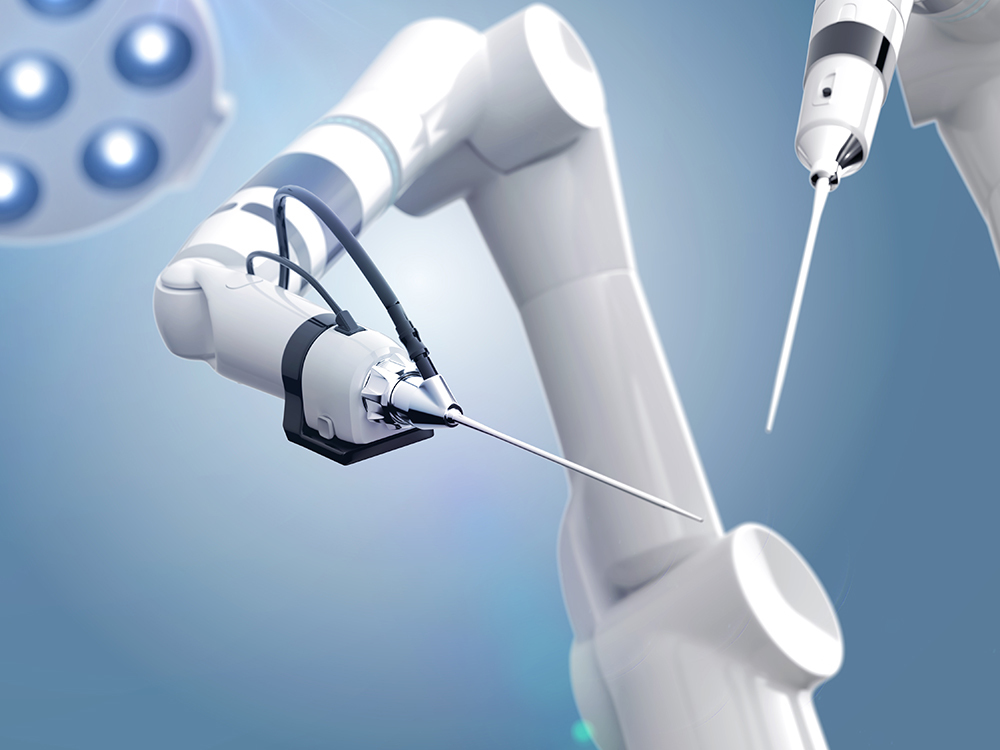
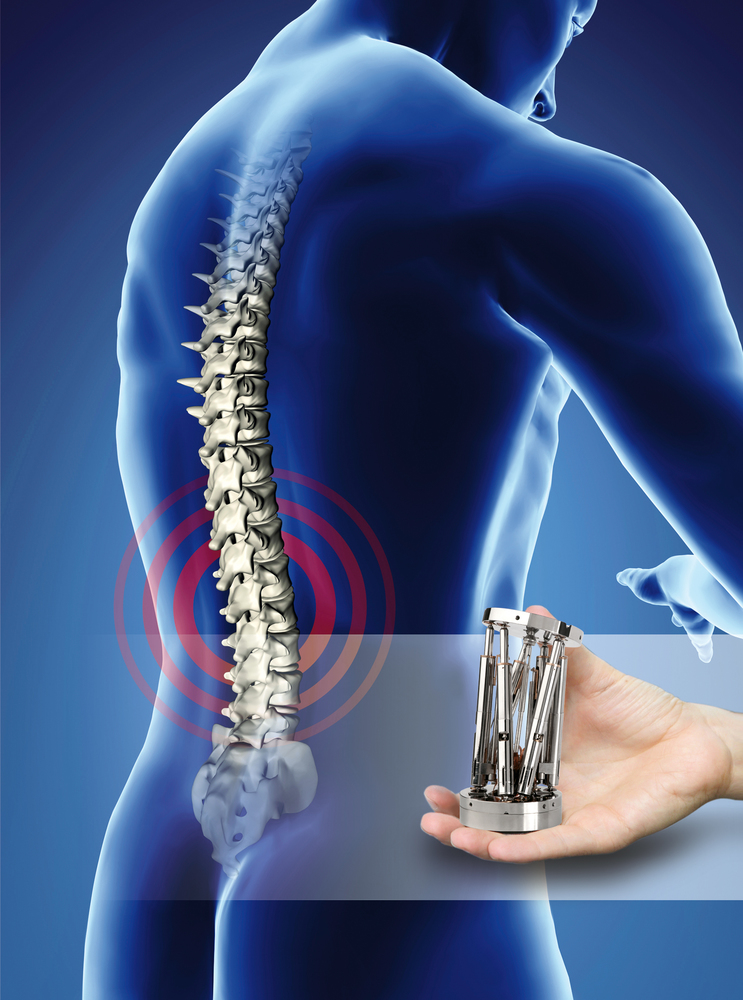



Spinal surgery demands absolute dexterity from surgeons. A miniature hexapod with six degrees of freedom provides highly precise assistance, acting as a guide. The SpineAssist system is fixed to the bone and allows for absolute precision when inserting implants to stabilize spinal fusions in open and minimally invasive surgical procedures.
The system includes a software package for preoperative planning that supports automatic fluoroscopic and CT image processing, as well as a set of rigid bone fixation clamps and platforms.
Mazor Surgical Technologies, inventor of the SpineAssist system and founder of the surgical method on which it is based, was established in 2001 as a spin-off from the Department of Mechanics at the Israel Institute of Technology. The company has offices in Caesarea, Israel, and Norcross, Georgia, USA (Mazor Surgical Technologies Inc.). Mazor specializes in the development of medical robotic systems, with the manufacturing of precision mechanical components outsourced to the Swiss company MPS Micro Precision Systems AG, a member of the FAULHABER Group.
Accuracy is of paramount importance when inserting implants in spinal surgery, as procedures are primarily performed in the vicinity of nerve roots and the spinal cord, and every millimeter can be crucial. Therefore, and also due to other biomechanical requirements, precision and accuracy are of utmost importance in this type of procedure.
Spinal fusion is a surgical intervention used, for example, to straighten the spine in order to counteract progressive deformation due to scoliosis or similar conditions.
The procedure is also used to support a weakened or damaged spine, or to counteract or alleviate pain caused by pinched or worn nerves. Although spinal fusions achieve remarkably high success rates, the incidence of implant misplacement is alarmingly high. According to some sources, this occurs in as many as 25% of scoliosis-related procedures. Misplacement is associated with an increased risk of neural and vascular complications, as well as injury to the spinal meninges.
The SpineAssist intervention consists of five steps: 1) preoperative planning phase based on a CT scan of the spine; 2) rigid fixation of the SpineAssist platform to the patient's spine; 3) position calibration by comparing a fluoroscopic image of the bone-mounted platform with a CT scan from the preoperative planning phase; 4) rigid fixation of the SpineAssist robot to the platform; 5) precise automatic positioning of the robotic guide arm based on the information from the preoperative plan to guide the surgeon during drilling and other procedures. The SpineAssist procedure is FDA-approved, CE-marked, and has been clinically tested in 250 cases worldwide to date.
Minimally invasive surgery (MIS) is one of the most significant developments currently taking place in the medical device industry. The potential advantages of minimally invasive procedures are manifold: a smaller incision—and therefore less scarring—reduces the risk of infection and bleeding. Furthermore, minimally invasive techniques can reduce postoperative pain and trauma, and shorten hospital stays and recovery times; this is one of the reasons why the medical device industry is continuously working on developing new instruments for use in minimally invasive surgery.
The SpineAssist system enables spinal fusion procedures to be performed with only a few small incisions, whereas the comparatively large incisions required by conventional surgical methods can lead to potential muscle damage. The robot's exceptionally small dimensions, the fact that no direct line of sight is required, and the method's high precision facilitate the surgical procedure and minimize the risk of screw misplacement. Because the robot is rigidly fixed to the patient, no coordinate tracking system is needed. SpineAssist requires only a small number of fluoroscopic images for the procedure, resulting in a further significant reduction in radiation exposure for both surgeon and patient.
The SpineAssist robot
The Mini