



Fly-by-wire is a signal transmission technology for aircraft flight control. The pilot's control commands are evaluated and processed by the flight control computer, and transmitted as electrical signals to actuators. These convert the electrical signals into mechanical movement. Examples of such actuators are servo valves that hydraulically operate ailerons, rudder, and other control surfaces. This allows even the high forces of large commercial aircraft to be safely controlled.
Structure and operation of a servo valve:Servo valves are electromagnetically controlled riser valves consisting of a control sleeve, control piston, and electrical control unit. Depending on the position of the control piston, various hydraulic circuits can be opened or closed.
These servo valves typically consist of a control bushing and control piston, among other components. Burrs and increased friction between the bushing and piston result in friction, wear, and the risk of failure. Sharp or unevenly rounded edges can also negatively impact the flow characteristics when the valve is open. Identical valve behavior in the event of a replacement would therefore be difficult to guarantee. To ensure the necessary safety and stable, consistent function of the installed servo valves, the critical areas are remachined after mechanical production. Precise deburring and smoothing of roughness peaks, as well as the defined rounding of the edges of the control bushing and piston, not only reduces friction in the servo valve but also increases the contact area. This extremely precise machining also enables the realization of the tightest tolerances, which are crucial for the tightness of the system. Furthermore, higher switching and stroke frequencies can be achieved, which significantly increases control accuracy during operation.
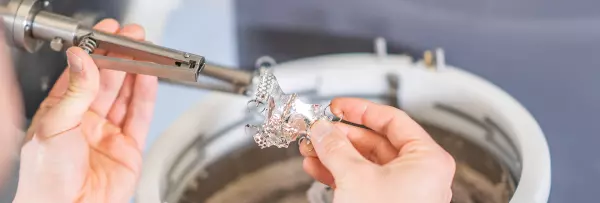
The post-processing of these components is currently often still done manually. In terms of efficiency and process reliability, this approach has significant disadvantages. The human factor plays a major role in manual processing. The processing result is literally in the hands of the processor. Whether the component meets the strict requirements or whether scrap is produced can vary from processor to processor or even from day to day. Costs must also not be ignored. Careful manual processing is time-consuming. Depending on the component size, on average only 3 to 4 components can be finished per person-hour.
The tools used in the manual process are subject to