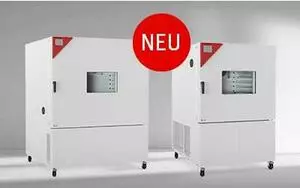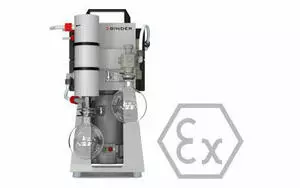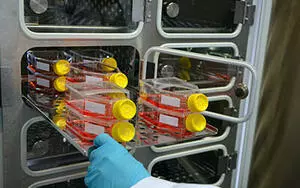

As a rule, both industrial and scientific laboratories use Ethernet interfaces to connect different types of devices such as dynamic climate chambers, constant climate chambers, CO 2 incubators, refrigerated incubators, vacuum drying chambers or ultra-low freezers to an internal network. However, not every room has the necessary Ethernet connection, which is required for smooth data exchange. Often the structural requirements are not met or there are too few connections. BINDER offers a suitable solution specifically for this demand and has recently added the WLAN kit accessory to its range.
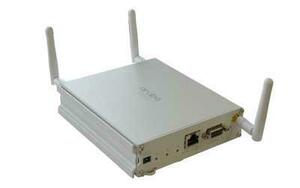
The WLAN kit enables a wireless connection between a BINDER chamber and either the BINDER APT-COM4 software, the standard LIMS monitoring system or customer-specific software. Equipped with three antennas that can be flexibly aligned, data is exchanged quickly via a powerful transmitter and receiver. Irrespective of the location and the spatial conditions, the users can thus always monitor and control their test material. The only requirement is a radio access point.
The set, consisting of an Aruba 501 Wireless Client Bridge, power supply unit, Ethernet cable (RJ45) and installation components, is suitable for indoor use. The Client Bridge can be attached anywhere using the supplied adhesive pads. The WLAN kit connects one device to a network at a time. If several devices are to be linked to the WLAN kit, an additional switch allows up to 10 devices to be used at the same time. Installation and configuration in a secure network is usually done by the customer's IT department. This ensures that the security guidelines of companies or institutes are always followed.
The control electronics of the BINDER devices are based on the same standards. This has the advantage that the WLAN kit can be used with all BINDER product families. Whether in material testing, in stem cell research or in plant growth: the WLAN kit creates flexible working conditions and improved comfort.